Saturday, March 22, 2014

Becoming New Creatures in Christ

Becoming New Creatures in Christ

Paul describes Christ using many titles and phrases such as Dear Son, image of the invisible God, first born of every creature, creator, head of the Church, the first resurrected being mediator—one to reconcile, hope, and glory. As Paul speaks of the Lord he also reminds us that Christ delivered us from darkness and made it possible to seek forgiveness of our sins. Paul also teaches us that the responsibility is in us as Christ decibels to continue on in faith grounded and settled. And so doing we will receive blessings.   

Furthermore in reading Colossians 2:7 we learn that we must be rooted and built up in him, and established in the faith.” This means that we must remember him always that though out firm belief we can overcome all things even those things that Satan would through at us. As we exercise our faith in God it grows stronger, cementing our foundation on his word.

Paul goes on to teach and warn us not to fall into the traps men set by teaching their own philosophies mixing them with scripture to sound true. He also warned against the worshiping of angels. Angels are not the mediator or gate keeper for God. A man cannot communicate with God by calling on and worshiping of angels (see Colossians 2:18). The Book of Mormon prophet Nephi adds that men can and are often misled by the cunning wit and flatteries of the devil to the vain nature of the wise and learned men. It is only by harkening the council of God that we can avoid the trappers snare (See Nephi 9:28-29).

Things We Should Seek After or “Put On”Things We Should “Mortify” or “Put Off”

Paul also taught about families and how each member of the household should treat each other. Husbands and wives should serve each other loving their children and children should lovingly obey their parents. This invites peace into the hearts of all and we should be thankful. The word of God should abound in our homes and we should sing hymns. As we sing hymns and spiritual songs we invoke the spirit of the Lord and again peace overcomes our hearts.


I love my God - I love my family - and I love the gospel of Jesus Christ. 

Thursday, March 20, 2014

Romans 6. Baptism


Romans 6. Baptism


Before we are baptized into the Church we must forsake our sins and stop committing them. The Apostle Paul teaches that we must not continue on in our sins, that God forbid it. If we desire to be baptized we must put our old selves away and burry the sinner that we can be resected into a new clean life (See Romans 6:1-13).

Prior to the crucifixion of Jesus Christ, he took upon himself the sins of the world atoning for all mankind In doing this he set the example that our sins should die with Christ on the cross e.g. we must repent and forsake our sins that we may not repeat them. In burying our sins unto death we can be reborn spotless and anew. Christ resurrection is symbolic in that we also are resurrected through baptism—in that we emerge from the water cleansed of our previous sins born again as a new person.

“Baptism cannot be by any other means than immersion of the entire body in water, for the following reasons:
1.      “It is in the similitude of the death, burial, and resurrection of Jesus Christ, and of all others who have received the resurrection.
2.      “Baptism is also a birth and performed in the similitude of the birth of a child in to the world.
3.      “Baptism is not only a figure of the resurrection, but also is literally a transplanting or resurrection from one life to another…” (Smith, Doctrines of Salvation, 2:323-24.)

There for in order to keep this newness we must remember, “the natural man is an enemy to God, and has been from the fall of Adam and will be,  forever and ever, unless he yields to the enticing of the Holy Spirit, and putteth off the natural man and becometh a saint through the atonement of Christ the Lord, and becometh as a child, submissive, meek, humble, patient, full of love, willing to submit to all things which the Lord seeth fit to inflict upon him, even as a child doth submit to his father…”(Mosiah 3:19 The Book of Mormon.)
As we continue on in righteousness let us remember who’s servant we are. If we are righteous then we are servants to righteousness, and also the Lord our God. However if choose to be sinners still then we are servants to sin and will find our reward with the devil. It is therefore by our obedience to the commandments of God that we find eternal life and everlasting freedom (See Romans 6:14–23).

Tuesday, March 11, 2014

The Impact of Example


The Impact of Example

The servants of the Lord or the Apostles of the Lord as referenced in 1 Corinthians 8 of the New Testament in the Kings James Bible are to be good stewards and examples of the word. They are to be faithful, wise in Christ—strong and honorable. They are also to be meek and will likely be despised for God’s sake—and suffer it. They are to be labors in the field and are called to warn all. These attributes are not singular to the apostles only, but are attributes all of Christ disciples should seek to obtain. 

In the Alma 39 of the Book of Mormon we learn just how important being a good example can be. The prophet in counselling his son informs us all the dangers of being a bad example in that we would lead the hearts of many people to destruction. He goes on to say that we should refrain from our iniquities and basically calls us to repentance. In 3 Nephi we learn that it is only true and just men who can deliver the word and work miracles and unless they are clean they cannot serve with authority. 
 
When I first joined the Church I kept experiencing a surprise reaction from my friends and coworkers when they would discover that I am a Latter-day Saint. They would all say things like, really? You are Mormon? I don’t see it.  This caused me to take a big look inward. What kind of example was I living if people were surprised to find out I am LDS? I prayed to know what to do and what to change and acting in faith adjusted my behavior to better reflect the things I believe. Now when people find out that I am Mormon, they say I thought you might be. I like that reaction a lot better. 

Because I choose to live my testimony; I can bear witness of the things I know to be true and have them rest on the heart of those that hear my testimony. People no longer doubt that what I believe, but are more curious than ever. I know that when we live according to the teachings of the Jesus Christ, his apostles, and prophets we can truly hasten the work of salvation in these latter days.

Tuesday, March 4, 2014

Proper Authority and Ministering to the People


Acts 19–20. Proper Authority and Ministering to the People

In the book of Acts chapter 19 and 20 we read of at least five priesthood ordinances that the Apostle Paul preformed. Namely, he baptized in the name of Christ, conferred the gift of the Holy Ghost, administering blessing to the sick and afflicted, casted out a demon, and raised the dead. All of this was done in the name of Jesus Christ and will proper priesthood authority.

As I studied these verses I was reminded of a question that was raised in the gospel principles class of my ward. The question raised by a visiting investor was, “If I have already been baptized, why would I need to be baptized again?” The investigator seemed to be hurt and very upset by the notion that his previous baptism was somehow not valid. The instructor quickly changed the lesson plan to cover the question more in depth asking the class to turn to chapter 20 of their manuals instead of chapter 4 which was listed on the black board. I remember us going over in detail the principle of baptism and the need for this ordinance to be conducted by someone having the proper authority. However, I do not recall being given a clearer example than the one that Paul shared.

They baptize his familyWhen the Apostle Paul was in Ephesus he came across some disciples and asked if they had received the Holy Ghost. The disciples replied they didn’t know what he was talking about. Then Paul asked how they were baptized seeing that they did not have the Holy Ghost. They replied that they were baptized according to John’s Baptism. Upon hearing this Paul set out to correct the work that had been done by administering the ordinance in the name of the Father, the Son, and the Holy Ghost, by the priesthood authority of Christ. In doing this, Paul shows us the importance not only of the ordinance, but also of the authority needed to perform the ordinance. Paul goes on to bestow the gift of the Holy Ghost to the disciples he has just baptized by the laying on of hands.

Further study reveals on which day the Sabbath was now being observed—it being the first day of the week namely, Sunday. Act 20:7 says, “And upon the first day of the week, when the disciples came together to break bread, Paul preached. The book of John gives us more insight as to why the Sabbath day was changed—John 20:1, 19. The Sabbath day was changed as a way to recognize the resurrection of the Savior Jesus Christ.

I know that Christ church has been restored to the earth even his priesthood authority also. I am grateful for this knowledge and am glad to share in it with all that care to come and see for themselves the truths of the gospel—in Jesus Name Amen.


Monday, February 24, 2014

A Summary of The Day of Pentecost


A Summary of The Day of Pentecost

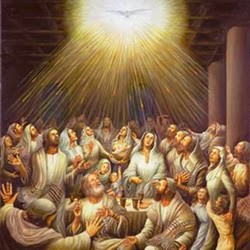
The day of Pentecost was a day of celebration fifty days after Christ resurrection. On that day many were visited by the Spirit of the Lord. They spoke in other tongues, received great visions, and prophesies were made. The apostle Peter taught that this was a fulfillment of Joel’s prophesies and that Christ had truly risen by the hand of God. Peter also fulfilled his role as a special witness of Jesus Christ in testifying of Christ innocence, crucifixion and his resection. Additionally Peter proclaimed that Christ’s disciples were not drunken like it was supposed by the many onlookers. Furthermore Peter cried out to the people to repent and be baptized for the remission of their sins and receive the gift of the Holy Ghost. It was said that they gladly received his word and were baptized that same day. It was also noted that they continued in steadfastness in the apostles’ doctrine and fellowship breaking bread and praying. Many theologians refer to this event as the birthdate of the Christian church.


Thursday, December 19, 2013

Final Assessment Essay: The Things I Learned


Dustin Morris
Danny Brownell
FDREL 211 ~ 29 (ONLINE)
December 19, 2013

Final Assessment Essay: The Things I Learned

Over the course of this semester I have learned a great deal about our Lord and Savior, his life, teachings, and even about his disciples. I found it most interesting that during his mortal life on earth, he preached love, repentance, mercy, and forgiveness. Then, after his resurrection he preached the importance of missionary work to his disciples. “Jesus saith to Simon Peter, Simon, son of Jonas, lovest thou me more than these?” To which Peter replies, “Yea, Lord; thou knowest that I love thee.” Then Christ gives him instructions to teach the gospel saying, “Feed my lambs.” Christ ask Peter two more times if he loves him and each time Peter says yes of course I do, to which Christ replies, “Feed my sheep.” Christ could not have made the importance of missionary work any clearer than this. If you love me, then feed my sheep. (John 21:15-17)


During his life Christ prayed often and in one instances an account was written in the book of Luke which says, “But I have prayed for thee, that thy faith fail not: and when thou art converted, strengthen thy brethren.” (Luke 22:32) Christ’s prayer was for us to have faith, to be converted, and when we have gained a testimony, we are to use it to strengthen others. Each of us as disciples of the Lord have tasted of the fruit that Lehi saw in his dream – and it is good. If we chose to live Lehi’s dream to the max, then we have to share our testimonies of the truth. Not because we have too, but because we want too. Remember if we love Christ, then we should be willing to follow his instructions to feed his sheep.

I know that many of us have testimonies of the principles of the gospel, but we often fall short of living up to them. That doesn’t make us bad people that makes us human, we are imperfect. Our desire to share the gospel is not dimensioned by hesitation to share it. Christ has told us that if we open our mouths, they will be filled, and we will become like Nephi of old. (Doctrine & Covenants 33:8-10)

In addition to missionary work, Christ often taught us about forgiveness and love. He showed us the importance of both in the parable of the prodigal son. As the story goes, there was a man who had two sons. Each of which stood to inherit all that their father had. One day one of the sons approached his father and asked if he could have his inheritance now instead of when his father passes away. With some hesitation his father obliged him and fulfilled his request.

The young man desired to break away from the restrictive traditions of his father. He sought to be free of what he felt were unfair rules and looked forward to exploring the world in his own right. Living lavishly and carelessly he soon found himself in quite the predicament. He was broke and indebt, living in squalor and literally eating with pigs from troths. It was then, and only after he had hit rock bottom that he realized his error. Covered in filth eating with pigs his heart was softened and he desired the true happiness he once had with his father at home. He remembered his father’s servants and felt that if only his father would take him back, he would live as a servant. For his father treated his servants well. He just knew if his father would have him, he could work off the debt of the squandered fortune and somehow return to his father’s good graces.


The young man mustered up the courage to make the long journey home, and in the distance his father saw him as he approached. With great joy and excitement his father greeted him with open arms and tremendous love. I can only imagine the reunion of a father and wayward son. I am sure the young man wept in his father’s embrace as he asked for forgiveness. What happens next is my favorite part. His father doesn’t seemed to be concerned about the errors the young man has made, he rather celebrate his return than focus on his sins. He tells his servants to prepare the fatted calf and to rejoice with him, as should we when any of our wayward friends return to the fold of the flock. If we ask for forgiveness, then it should be given, and we should remember the sins no more. (Luke 15: 11-32)


Finally we must have faith, faith in the Lord Jesus Christ. If we believe in the Him, without a doubt, then all things are truly possible. If you recall the story in Matthew about the stormy sea and the apostles, then you might remember what happened when Peter called out to the Lord. As Christ approached the ship, the disciples became afraid, thinking that Christ was a spirit or ghost. Peter calls out to him saying, “Lord, if it be thou, bid me come unto thee on the water.” “And he said, Come.” Peter leaped out the boat and walked for a moment on the water toward Jesus. It was only when he took his eyes off the Lord and focused on the tempos tossed seas did he begin to sink. Peter had faith to walk on water like Christ did; he also had faith to call upon him for help when he fell short saying, “Lord, save me.” And true to his character he immediately did so, stretching out his hand bringing safely back to the ship. (Matthew 12:22-33)

Through our faith all things are possible. Wayward steward can regain their blessing, hearts can be softened and people converted. As we testify of the truthfulness of the gospel sharing Christ love for the world we can hasten the work. I know this to be true I have seen it done in my own life. I was like the prodigal son; the more I sought freedom by rebelling against what I knew to be right, the further I fell into despair. It was only when a friend shared her testimony with me and invited me to come with her to church did I know there was a better way. And like the prodigal son, I was welcomed with open arms.

My faith has helped me remain true to the things I know to be right, and the scriptures have helped me draw nearer to my Father in Heaven. I know the Church is true. I know that there is a Christ. I know his order has been restored to the earth, and that he has called his prophet to lead and guide us in these latter days. Amen.